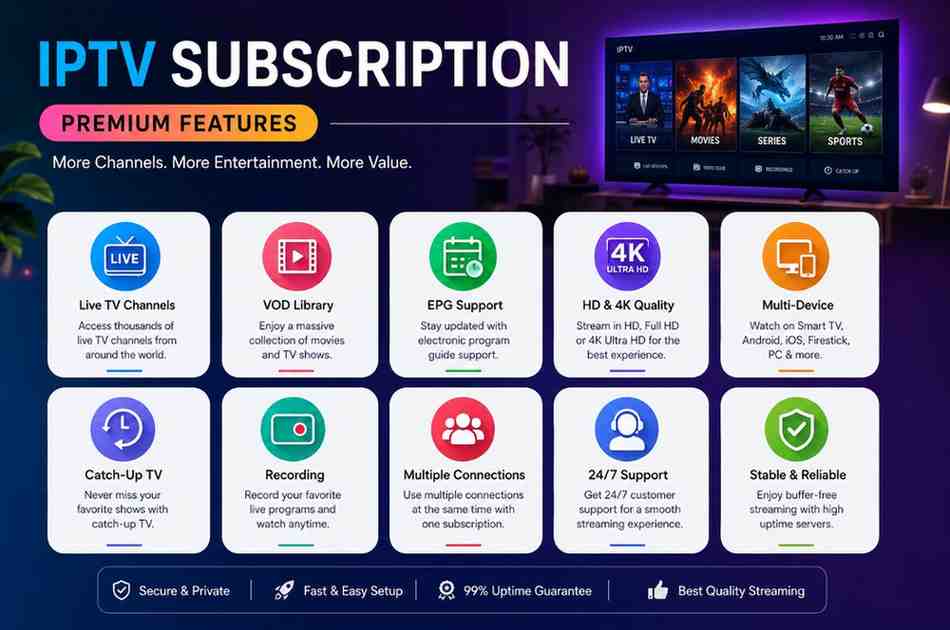
Buying an IPTV subscription is straightforward once you understand the market's key trade-offs: channel variety, stream stability, device support, and licensing legitimacy. A strong IPTV plan delivers thousands of live channels and on-demand titles at a fraction of cable's cost, but only when the provider operates reliable infrastructure. This guide walks you through the technical requirements, real-world pricing, provider verification steps, and the specific features that separate premium services from short-lived resellers. You'll finish this article knowing exactly what to buy, what to pay, and how to protect yourself from unreliable operators.
The IPTV market is crowded with hundreds of providers, ranging from premium licensed services to unregulated resellers that disappear within months. The difference between a great subscription and a frustrating one usually comes down to infrastructure: dedicated servers, CDN coverage, and anti-buffering technology. Understanding these layers helps you make a confident purchase decision rather than relying on marketing promises.
buy iptv subscription Summary
"Buy IPTV subscription" refers to purchasing access to an IP-based television service that streams live channels and on-demand video directly to your internet-connected devices. Its proven benefit is delivering 20,000+ live channels and 40,000+ VOD titles at roughly 80% less than cable, with instant activation and no contracts.
| Optimal ForCord-cutters, sports fans, and multilingual households seeking broad channel coverage without long-term cable commitments. | Key AdvantageMulti-device streaming in up to 4K UHD quality across Smart TVs, Firestick, Android, iOS, and MAG boxes. |
- ✓ Key Strength: Access to 20,000+ live channels spanning sports, news, entertainment, and international markets.
- ✓ Key Strength: 99.9% uptime backed by anti-freeze streaming technology for buffer-free viewing.
- ✓ Peace of Mind: 24/7 customer support, a free trial, and a money-back guarantee on eligible plans.
In This Guide
- 1. How IPTV Subscription Works
- 2. Pros and Cons: What to Weigh Before Buying
- 3. IPTV Comparison: Premium vs. Cable vs. Free Apps
- 4. Cost-Benefit Analysis: Is IPTV Worth It?
- 5. Who Should Buy IPTV Subscription
- 6. Legal and Security Considerations
- 7. How to Choose a Reliable IPTV Provider
- 8. Frequently Asked Questions
How IPTV Subscription Works: The Technical Reality
IPTV (Internet Protocol Television) delivers television content through your internet connection rather than terrestrial, satellite, or cable signals. When you buy IPTV subscription, you're essentially purchasing access to a provider's streaming servers, which relay live TV channels and stored video-on-demand content to your device in real time. The architecture is fundamentally different from cable: instead of broadcast signals flowing through coaxial cables, IPTV transmits video data as IP packets over your broadband connection.
The technical flow is simple in principle: your device sends a request to the IPTV provider's server, the server streams the requested channel or VOD file as IP packets, and the IPTV application decodes and renders the content on your screen. Unlike Netflix or YouTube, which rely on adaptive bitrate streaming through content delivery networks optimized for on-demand content, IPTV services prioritize low-latency delivery for live broadcasts. This makes server infrastructure the single most important quality factor in your viewing experience. A provider with geographically distributed servers and high-bandwidth uplinks will deliver smooth streams; a provider operating from a single overloaded server will produce constant buffering, pixelation, and channel freezes during peak evening hours.
Three service categories exist within IPTV, and most premium subscriptions bundle all of them:
- Live Television: Real-time broadcast of channels, similar to cable or satellite, covering sports, news, entertainment, and international programming.
- Video-on-Demand (VOD): A searchable catalog of movies, TV series, documentaries, and exclusive content you can watch at any time.
- Time-Shifted TV: Catch-up television that allows you to replay previously broadcast content within a defined window, typically 24 to 72 hours.
The technical requirements for smooth IPTV streaming are consistent across providers. For full HD (1080p) quality, you need a stable download speed of at least 25 Mbps; for 4K UHD streams, plan for 50 Mbps or higher. Device compatibility is broad: Android and iOS smartphones, Smart TVs (Samsung, LG, Sony), Amazon Firestick, MAG set-top boxes, Windows and macOS computers, and even some gaming consoles. Ethernet connections are always preferable to Wi-Fi for 4K content, as they eliminate wireless interference and provide consistent throughput.

Pros and Cons: What to Weigh Before Buying IPTV Subscription
Every IPTV subscription involves a trade-off between cost savings and potential service variability. A balanced evaluation requires looking at both the advantages that make IPTV attractive and the limitations that cause legitimate complaints.
✓ What Works Well
|
✗ Limitations to Consider
|
IPTV Comparison: Premium vs. Cable vs. Free Apps
To contextualize what you get when you buy IPTV subscription, it helps to compare a premium IPTV service against the two most common alternatives: traditional cable television and free IPTV applications. The differences in cost, content volume, and user experience are substantial.
| Feature / Metric | Premium IPTV | Cable TV | Free IPTV App |
|---|---|---|---|
| Monthly Cost | $12–$25 | $80–$150 | $0 (ad-supported) |
| Live Channels | 20,000+ | 150–300 | 500–1,000 |
| VOD Library | 40,000+ titles | Limited add-on | Minimal |
| Max Streaming Quality | 4K UHD / FHD | 1080p | 720p |
| Device Support | 6+ platforms | Set-top box only | 2–3 platforms |
| Customer Support | 24/7 live chat | Phone, business hours | None |
| Free Trial | Yes (24–48h) | No | N/A |
| Contract Required | No | 12–24 months | No |
Cost-Benefit Analysis: Is Buying IPTV Subscription Worth It?
From a purely financial standpoint, the math strongly favors IPTV. The average cable subscription in the United States costs $100 per month, translating to $1,200 annually. A premium IPTV subscription with a broader channel lineup typically costs between $12 and $25 per month, or $144 to $300 annually. Even at the highest premium tier, you save a minimum of $900 per year while gaining access to more channels, a larger VOD library, and multi-device streaming capability.
Most providers structure their pricing to reward longer commitments. Standard pricing tiers in the verified premium market are:
- 1-month plan: $12–$20 — ideal for testing a provider's reliability before committing.
- 3-month plan: $30–$45 — the sweet spot for evaluating seasonal sports coverage.
- 6-month plan: $50–$70 — balanced savings with moderate commitment.
- 12-month plan: $80–$120 — maximum savings, typically 50% off the monthly equivalent.
The hidden costs to factor in are your internet connection and, potentially, a streaming device. If you already have broadband internet for everyday use, there is no marginal cost increase. A Firestick or Android box costs $30 to $60 as a one-time purchase, which still leaves you hundreds of dollars ahead compared to cable within the first year.
Who Should Buy IPTV Subscription (and Who Shouldn't)
IPTV is not a universal solution. It excels in specific use cases and falls short in others. Being honest about your viewing habits and technical comfort level before purchasing will prevent disappointment.
Ideal Candidates for IPTV
- Sports enthusiasts who want multiple sports packages (Premier League, NBA, UFC, cricket, F1) without paying for separate streaming services that each cost $20–$30 monthly.
- Expatriates and multilingual households seeking home-country channels that cable providers don't carry. Premium IPTV services aggregate channels from dozens of countries, including Arabic, South Asian, Latin American, and European markets.
- Budget-conscious cord-cutters who want the cable experience at a fraction of the price, with the flexibility to cancel anytime.
- Multi-device households where different family members watch on different screens simultaneously. Most premium plans support 2 to 5 concurrent connections.
Who Should Skip IPTV
- Users with internet below 20 Mbps — IPTV requires consistent bandwidth; unstable connections produce continuous buffering that ruins live events.
- Those unwilling to troubleshoot initial setup — configuration typically takes 5–15 minutes, but some older devices require manual app installation or portal URL entry.
- Viewers in jurisdictions with aggressive IPTV enforcement — in certain countries, accessing unlicensed IPTV services carries legal risk. Verify your local regulations before purchasing.
Legal and Security Considerations When You Buy IPTV Subscription
The legal landscape of IPTV is nuanced. IPTV technology itself is completely legal; the legality depends on whether the provider has secured broadcast rights for the content it distributes. Licensed providers negotiate rights with content owners and operate transparently, often displaying company registration, terms of service, and refund policies. Unlicensed services stream copyrighted content without authorization, which creates legal exposure for both the operator and, in some jurisdictions, the end user.
Several red flags immediately identify a problematic provider. Be wary of any service priced under $10 per month that advertises "all channels worldwide" — legitimate rights to such content would cost millions annually. Additionally, watch for these warning signs:
- No company information, physical address, or legal documentation on their website.
- Payment only via cryptocurrency or untraceable methods, making refunds impossible.
- No HTTPS encryption on their website — a basic security failure indicating amateur operation.
- Pressure to purchase long-term plans before testing a free trial.
- Disappearing social media accounts or frequently changing domain names.
For your own security, always pay with a credit card or a reputable payment processor that offers chargeback protection. Never share your home IP address with a suspicious service, and consider using a VPN to protect your privacy during streaming and setup.
How to Choose a Reliable IPTV Provider
Choosing a provider is the most consequential decision you'll make when you buy IPTV subscription. The following checklist compiles the criteria used by professional evaluators and experienced users to separate premium services from unreliable operations.
- Verify licensing claims. Legitimate providers publish their legal structure, content licensing partnerships, and compliance information. Contact customer support and ask directly about licensing — evasive answers are a red flag.
- Test the free trial first. A provider confident in its service will offer a 24- or 48-hour free trial. Use this window to test channel variety, stream stability, and picture quality during peak hours (8 PM–11 PM local time).
- Audit the channel lineup. Compare the advertised channel list against your actual viewing habits. A service with 20,000 channels is worthless if the 15 channels you watch daily are missing or unstable.
- Check server reliability during peak hours. The true test of an IPTV service is performance at peak viewing time. If the free trial buffers during prime evening hours, the service is undersized.
- Review the refund policy. Reputable providers offer at least a 7-day money-back guarantee on paid plans. Avoid any service without a written refund policy.
- Confirm device compatibility. Verify that the service supports your specific devices — Samsung Smart TVs require different apps than Android or Firestick. Some providers also offer custom APKs for sideloading.
- Evaluate customer support responsiveness. Send a pre-sales question via live chat and measure the response time. Premium services respond within minutes; unreliable ones may take days or never respond.
- Read independent reviews. Search for reviews on Trustpilot, Reddit communities (r/IPTV), and IPTV-focused forums. Look for patterns of complaints about downtime, poor support, or account blocking.
The Bottom Line on Iptv Subscription
If you want the channel breadth and cost savings of IPTV without the reliability headaches, choose a verified provider with licensed infrastructure and a testable free trial. The official option reviewed here meets every criterion outlined in this guide and is backed by responsive 24/7 customer support.
Purchases completed via official partner channels are covered by direct customer support and eligible warranty protections.
Frequently Asked Questions
Is buying an IPTV subscription legal in the United States and Europe?
IPTV technology is legal in both the US and the EU. The legality depends entirely on whether the provider holds broadcast rights for the content it streams. Licensed providers operate within the law; unlicensed services that distribute copyrighted content without authorization are illegal. As a consumer, you reduce legal risk by choosing providers that transparently document their licensing agreements.
How much should I expect to pay for a reliable IPTV subscription in 2026?
A reliable premium IPTV subscription costs between $12 and $25 per month, depending on plan length and features. Annual plans typically range from $80 to $120. Be suspicious of services priced under $10 per month; they generally lack proper server infrastructure, licensing transparency, and customer support, which leads to buffering and sudden shutdowns.
What internet speed do I need to stream IPTV in 4K without buffering?
For smooth 4K UHD IPTV streaming, you need a stable download speed of at least 50 Mbps. Full HD (1080p) streaming requires a minimum of 25 Mbps. Equally important is connection stability: a fast but inconsistent connection will still cause buffering. Using a wired Ethernet connection instead of Wi-Fi significantly improves stream stability for 4K content.
Can I use one IPTV subscription on multiple devices at the same time?
Most premium IPTV subscriptions allow 2 to 5 concurrent connections, meaning different devices can stream simultaneously under one subscription. The exact allowance varies by provider, so verify this before purchasing. Households with heavy multi-screen usage should confirm the connection limit and avoid providers that restrict to a single device.
What is the actual difference between IPTV and streaming services like Netflix?
Netflix and similar platforms are VOD-only services: you select from a library of licensed content and stream it on demand. IPTV combines live television channels, VOD, and time-shifted catch-up TV in one interface. IPTV is best understood as a direct cable replacement, while Netflix complements rather than replaces live TV viewing.
How can I tell if an IPTV provider is legitimate or a reseller scam?
Legitimate providers publish company registration details, maintain transparent refund policies, offer free trials, and provide responsive live chat support. Scam resellers typically operate without business documentation, demand cryptocurrency-only payment, use newly registered domains, and offer prices below $10 per month. Always test the free trial and contact support with a pre-sales question before paying.
Do IPTV subscriptions offer free trials and money-back guarantees?
Reputable premium IPTV services offer a 24- to 48-hour free trial so you can test channel quality and stream stability before paying. Paid plans are typically backed by a 7-day money-back guarantee. If a provider offers neither a trial nor a refund policy, that is a significant red flag indicating low confidence in their own service quality.
What should I do if my IPTV service buffers or goes offline during a live event?
First, rule out your own network: restart your router, check your internet speed, and switch to an Ethernet connection if possible. If the issue persists, contact the provider's live chat support immediately — premium services monitor stream health and can switch you to a backup server. If buffering occurs consistently during peak hours, the provider's infrastructure is undersized, and you should exercise your money-back guarantee and switch providers.
Transparency & Disclosure: We independently evaluate products. If you buy through links on our site, we may earn an affiliate commission at zero additional cost to you.