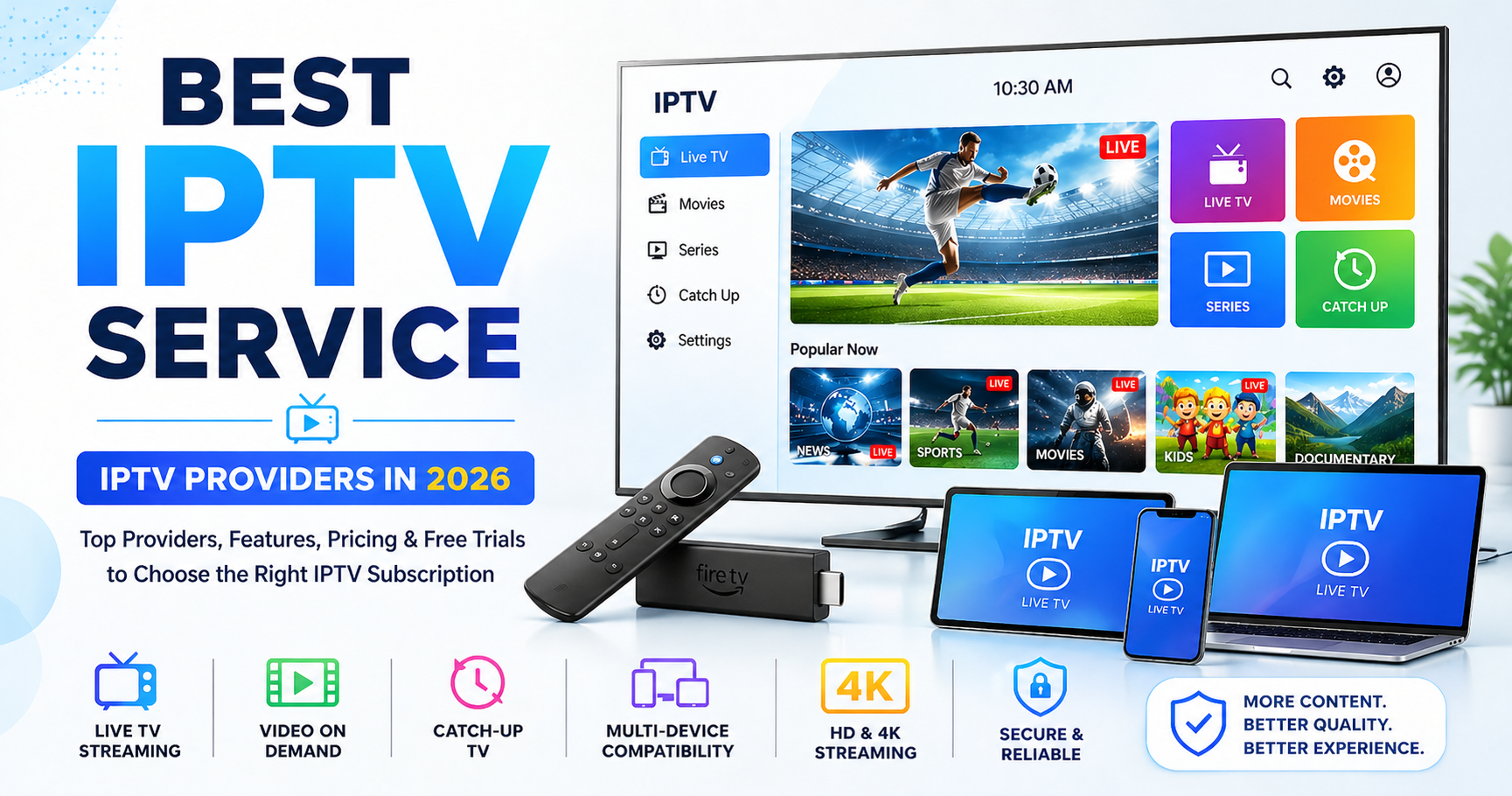
An IPTV service delivers television content over the internet rather than through traditional satellite or cable infrastructure. Instead of relying on broadcast signals, IPTV streams media through your broadband connection, giving you access to thousands of live channels, on-demand movies, sports packages, and international programming from a single subscription. For cord-cutters and entertainment enthusiasts, the right IPTV service can slash your monthly TV bill by 60% or more while expanding your viewing options dramatically.
This guide breaks down how IPTV services work, what separates premium providers from unreliable ones, and exactly how to choose a platform that delivers consistent 4K streaming, minimal buffering, and dependable customer support. You'll leave with a clear evaluation framework and a direct recommendation for the most reliable IPTV service available today.
IPTV Service Summary
The best IPTV service combines 20,000+ live channels, a robust video-on-demand library, 4K UHD streaming with anti-freeze technology, and 24/7 customer support — all for under $15 per month. Premium providers differentiate themselves through server stability, electronic program guide (EPG) accuracy, and multi-device compatibility that keeps every screen in your home connected.
| Optimal ForCord-cutters, sports fans, international viewers, and households streaming on 3+ devices simultaneously | Key AdvantageAnti-freeze 4K streaming with 99.9% uptime and instant channel switching across all major devices |
- ✓ Key Strength: 20,000+ live channels covering 120+ countries with localized language support
- ✓ Key Strength: 40,000+ movies and series in the VOD library updated weekly with new releases
- ✓ Peace of Mind: 24/7 live chat support and a 7-day money-back guarantee on all subscription plans
In This Guide
How IPTV Service Works: The Real Mechanics
Unlike cable television that broadcasts all channels simultaneously and relies on your tuner to filter the signal, an IPTV service uses your internet connection to deliver only the content you request. When you select a channel or press play on a movie, your device sends a request to the provider's server, which streams the content in small data packets using the Internet Protocol (IP). This on-demand delivery model is far more bandwidth-efficient and enables features cable simply cannot offer, like pause-and-rewind live TV, instant channel switching, and personalized content libraries.
The technical architecture of a premium IPTV service relies on three core components: the content acquisition layer (where broadcast signals are captured and encoded), the middleware (which manages user authentication, billing, and the electronic program guide), and the content delivery network (CDN) that distributes streams across geographically distributed servers. When a provider claims "anti-freeze technology," they're referring to intelligent routing that automatically shifts your connection to the least congested server path, minimizing buffering even during peak evening hours when internet traffic spikes nationwide.
For the end user, the experience is remarkably simple. You install a compatible app — available for Android TV, Fire Stick, iOS, Windows, macOS, or even a dedicated MAG box — enter your credentials, and the electronic program guide populates with thousands of channels organized by category. Sports, news, entertainment, documentaries, kids' programming, and international channels from regions like the UK, India, Latin America, and the Middle East are all accessible from a single interface. The best IPTV services also offer catch-up TV, letting you watch shows from the past 7 days, and a searchable video-on-demand library with 40,000+ titles.
IPTV Service Pros & Cons: What to Expect
Every IPTV service has trade-offs, and understanding them before committing prevents frustration down the road. Here's an honest breakdown of the strengths and limitations you'll encounter with premium IPTV platforms.
✓ Pros
|
✗ Cons
|

IPTV vs. Cable vs. Satellite: Full Comparison Table
To make an informed decision, it helps to see exactly how an IPTV service stacks up against traditional television delivery methods across the metrics that matter most.
| Feature / Metric | IPTV Service | Cable TV | Satellite TV |
|---|---|---|---|
| Monthly Cost | $10–$15 | $80–$150 | $70–$130 |
| Channel Count | 20,000+ | 200–500 | 150–300 |
| Max Video Quality | 4K UHD | 1080p (most) | 4K (limited) |
| Device Flexibility | Any internet-connected device | TV only (set-top box) | TV only (dish + receiver) |
| Video-on-Demand Library | 40,000+ titles | 5,000–10,000 | 5,000–8,000 |
| Weather Vulnerability | None (internet-based) | None (wired) | High (rain/snow fade) |
| Equipment Rental | None (BYO device) | $10–$20/month | $8–$15/month |
| Contract Required | No (monthly plans) | Often 12–24 months | Often 24 months |
| International Channels | 120+ countries | Limited add-on packages | Limited add-on packages |
The data is clear: an IPTV service delivers dramatically more content at a fraction of the cost, with greater flexibility and no long-term contracts. The only requirement is a reliable internet connection — which most households already have.
Cost-Benefit Analysis: Is IPTV Worth It?
Let's put real numbers behind the decision. The average American household spends $117 per month on cable television, according to the latest FCC pricing data. Over a year, that's $1,404. A premium IPTV service at $15 per month costs $180 annually — a savings of $1,224 per year. Even when you factor in a streaming device like a Fire Stick ($40 one-time) and a modest internet upgrade if needed, you're still saving over $1,000 in the first year alone.
Beyond raw cost, consider the value of what you gain. A typical cable package includes 250 channels, but most viewers actively watch fewer than 20. An IPTV service offers 20,000+ channels, meaning you gain access to regional sports networks from across the country, international news in multiple languages, niche documentary channels, and premium movie networks — all without paying per-channel add-on fees. The video-on-demand library alone often replaces subscriptions to Netflix, Hulu, and Disney+ for many users, creating additional monthly savings of $25–$40.
The hidden value lies in features cable simply cannot match: 7-day catch-up TV so you never miss a show, cloud DVR with unlimited storage, and the ability to watch your home channels while traveling on any device. For sports fans, the ability to stream out-of-market games without paying for expensive sports packages is often the single deciding factor.
Who Should Buy an IPTV Service?
An IPTV service isn't for everyone, but it's an exceptional fit for several specific user profiles. If you recognize yourself in any of these descriptions, the switch to IPTV is likely to save you money and improve your viewing experience.
- Cord-cutters and budget-conscious households: If you're paying $100+ monthly for cable and watching only a fraction of the channels, IPTV eliminates the waste while expanding your options. The annual savings of $1,000+ can fund other priorities.
- Sports enthusiasts: Regional sports networks, international leagues, pay-per-view events, and out-of-market games are all accessible through IPTV at a fraction of what cable sports packages cost. Many providers offer dedicated sports categories with multi-angle viewing.
- International viewers and expats: Staying connected to home-country programming — news, soap operas, cricket, football, or cultural channels — is one of the strongest reasons people choose IPTV. Providers carry channels from 120+ countries with native language support.
- Multi-device households: If your family watches TV on phones, tablets, laptops, and TVs simultaneously, IPTV's multi-device support (typically 3–5 concurrent connections) is far more flexible than cable's single set-top box limitation.
- Travelers and RV owners: Because IPTV streams over the internet, your subscription works anywhere with connectivity. Hotel Wi-Fi, RV parks, or a friend's house — your channels follow you.
Buyer Considerations: Red Flags to Avoid
The IPTV market has grown rapidly, and with growth comes a mix of quality providers and unreliable operators. Before committing to any IPTV service, evaluate these critical factors to avoid wasting money on a platform that buffers constantly, disappears overnight, or ignores support tickets.
Server infrastructure and uptime. The most common complaint with budget IPTV services is buffering during peak hours (7 PM–11 PM). Premium providers invest in dedicated servers and CDN routing to maintain consistent performance. Look for providers that publish uptime statistics — 99.9% uptime is the gold standard. Free trials are the best way to test real-world performance on your own connection before paying.
Customer support responsiveness. When the stream goes down during a critical match or your subscription doesn't activate, you need help immediately. The best IPTV services offer 24/7 live chat with average response times under 5 minutes. Test the support channel before purchasing — send a pre-sales question and measure how quickly you get a substantive reply.
Device compatibility. Confirm the IPTV service supports the devices you actually own. Fire Stick, Android TV, and iOS are standard, but if you use a specific Smart TV brand (Samsung, LG, Sony) or a MAG box, verify native app availability. Some providers require sideloading APK files, which adds friction; premium services offer one-click installation guides for every major platform.
Content licensing and legitimacy. The IPTV landscape includes both licensed providers and gray-market operations. Licensed providers charge slightly more but offer stability, legal protection, and accountability. Red flags include prices that seem impossibly low (under $5/month for "everything"), pressure to pay via cryptocurrency only, and no published company information. A reputable IPTV service will clearly identify its business entity and offer standard payment methods.
Refund policy and plan flexibility. The best IPTV services back their product with a 7-day money-back guarantee and offer monthly plans without long-term commitments. Avoid providers that require 6-month or annual prepayment upfront — this is a common pattern among fly-by-night operations that disappear after collecting payments.
The Bottom Line on IPTV Service
If you're ready to cut your TV bill by 80% while gaining access to 20,000+ channels, a premium IPTV service is the smartest entertainment investment you can make. Choose a provider with proven server stability, 24/7 support, and a money-back guarantee — and you'll never look back at cable.
Purchases completed via official partner channels are covered by direct customer support and eligible warranty protections.
Frequently Asked Questions
Is an IPTV service legal?
The legality depends on the specific provider. Licensed IPTV services that secure proper broadcast rights from content owners operate fully within the law. Gray-market providers that stream content without licensing operate in a legal gray area that varies by jurisdiction. For peace of mind, choose a provider that transparently identifies its business and holds appropriate licensing — these services cost slightly more but eliminate legal risk entirely.
What internet speed do I need for IPTV service?
For standard definition, 4–5 Mbps is sufficient. Full HD (1080p) requires at least 10 Mbps. For 4K UHD streaming, a stable 25 Mbps connection is recommended. Keep in mind that these figures apply per simultaneous stream — if three devices are watching at once, multiply accordingly. A wired Ethernet connection provides more stability than Wi-Fi for 4K content.
Can I watch IPTV on my Smart TV?
Yes. Most premium IPTV services offer native apps for Samsung, LG, and Sony Smart TVs. If your TV uses a different operating system, you can use a Fire Stick, Roku, or Android TV box as an affordable adapter. The setup typically takes under 5 minutes — download the app, enter your credentials, and the channel guide populates automatically.
What's the difference between IPTV and streaming services like Netflix?
Netflix and similar services offer a curated, licensed library of on-demand content. An IPTV service delivers live television channels in real time — exactly like cable — plus a video-on-demand library. Think of IPTV as a cable replacement and Netflix as a supplement. Many IPTV users find the VOD library covers most of what they'd watch on Netflix, allowing them to cancel multiple streaming subscriptions.
How many devices can I use simultaneously with one IPTV subscription?
This varies by provider. Budget services typically allow 1–2 concurrent connections. Premium IPTV services commonly support 3–5 simultaneous streams, which covers most households. If you need more, check whether the provider offers a family plan or additional connection add-ons. Always confirm the simultaneous stream limit before purchasing.
Do IPTV services offer a free trial?
Reputable providers offer a 24-hour free trial or a 7-day money-back guarantee. These trial windows let you test streaming quality, channel selection, and EPG accuracy on your own internet connection. Be wary of providers that refuse trials — this is often a sign of poor service quality. Always test during peak evening hours, as that's when buffering issues surface.
Can I record shows with an IPTV service?
Yes. Most premium IPTV services include cloud DVR functionality, allowing you to record live programming and watch it later. Storage limits vary by provider — some offer unlimited cloud DVR, while others cap at 100–500 hours. Additionally, the catch-up TV feature automatically makes the past 7 days of most channels available on demand, reducing the need to manually schedule recordings.
What happens if my IPTV service buffers or goes down?
First, check your internet connection — a minimum of 10 Mbps is needed for smooth HD streaming. If your connection is solid, the issue is on the provider's side. Premium IPTV services offer 24/7 live chat support and typically resolve server issues within minutes. Providers with anti-freeze technology automatically route around congested servers. If buffering persists, contact support — persistent issues may warrant a refund under the guarantee.
Transparency & Disclosure: We independently evaluate products. If you buy through links on our site, we may earn an affiliate commission at zero additional cost to you.