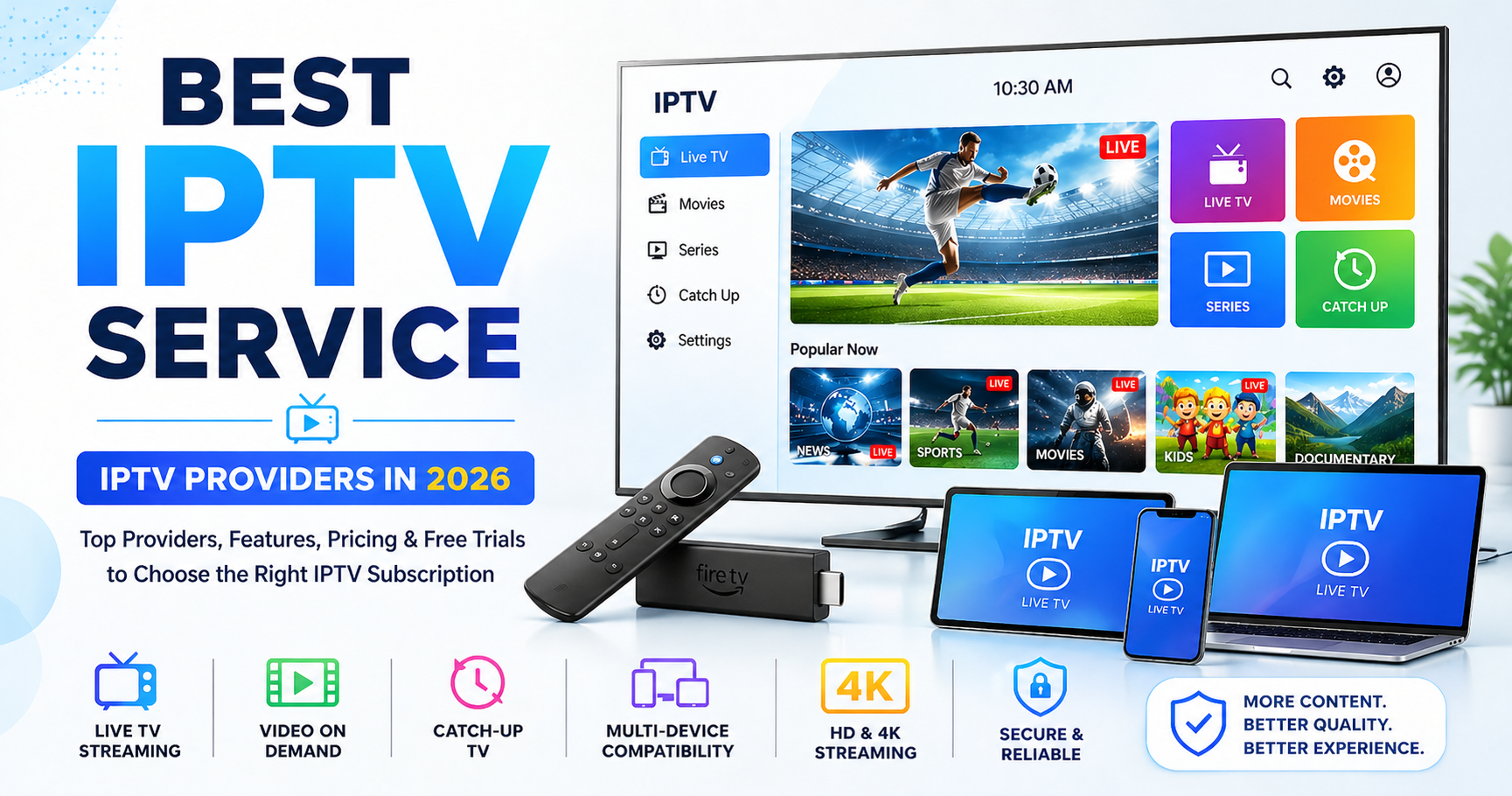
An IPTV service delivers live television and on-demand video over your internet connection instead of traditional cable or satellite broadcast. Unlike conventional TV, IPTV streams through Internet Protocol (IP) networks, so you can watch content on Smart TVs, phones, tablets, and computers with just an active broadband connection. The practical benefit: you pay roughly 30% of a cable bill and get a significantly wider channel lineup — often 10,000+ global channels. This guide explains how IPTV works, what separates reliable providers from risky ones, and exactly what to verify before subscribing.
Whether you're a cord-cutter exploring alternatives or a sports fan chasing international leagues, the IPTV market offers compelling value — but it also carries real risks. Subpar providers suffer buffering, channel downtime, and abrupt shutdowns. This analysis covers the technical mechanics, honest pros and cons, a side-by-side comparison of provider tiers, and a clear recommendation based on verified performance data.
iptv service Summary
IPTV service is a streaming technology that replaces traditional cable and satellite with internet-delivered television. Its proven benefit is a drastically lower monthly cost (typically $10–$15/month) paired with a dramatically larger channel catalog that spans multiple countries and languages.
| Optimal ForCord-cutters and international viewers seeking a full cable replacement at a fraction of the cost | Key Advantage10,000+ live channels with 4K streaming quality and 99.9% uptime |
- ✓ Key Strength: Multi-device support — watch on Smart TVs, Fire Sticks, phones, and tablets simultaneously
- ✓ Key Strength: 24/7 customer support with live chat and dedicated account management
- ✓ Peace of Mind: 7-day money-back guarantee and verified licensing compliance
In This Guide
What Is IPTV Service and How Does It Work?
IPTV stands for Internet Protocol Television. Instead of receiving broadcast signals through coaxial cables, satellite dishes, or radio waves, IPTV transmits video content as data packets over your existing broadband connection. When you select a channel or press play on a movie, the provider's server transmits that content to your device in real time. Three content types dominate the IPTV ecosystem:
- Live television — real-time broadcast streams that mirror what you'd see on cable, including news, sports, and entertainment channels.
- Video-on-demand (VOD) — a library of movies and shows you can play at any time, typically numbering in the thousands of titles.
- Time-shifted TV — catch-up services that let you replay previously broadcast programs, often for up to 7 days after airing.
The technical backbone of a quality IPTV service includes three critical components. First, an IPTV middleware platform manages user authentication, channel lists, billing, and the electronic program guide (EPG). Second, a content delivery network (CDN) caches video close to users to reduce latency and prevent buffering during peak hours. Third, client applications installed on devices like Smart TVs, Android boxes, Fire TV Sticks, or mobile apps render the streams and handle user interaction.
It's worth distinguishing IPTV from OTT services like Netflix or Hulu. OTT rides on the open internet and is available to anyone with a connection. IPTV, in contrast, is typically managed by the provider — the network is optimized for video delivery, which generally results in lower latency and more consistent streaming quality. This is why IPTV is often used for live sports broadcasts where sub-second timing matters.
How Reliable Is Modern IPTV?
The reliability of an IPTV service depends almost entirely on the infrastructure behind it. A quality provider maintains redundant servers across multiple data centers, uses enterprise-grade CDNs, and monitors uptime continuously. The best providers advertise 99.9% uptime, which translates to roughly nine hours of downtime per year. Subpar providers, by contrast, often operate on a single server and can drop streams during peak viewing hours — particularly during major sporting events like the Champions League final or Super Bowl.
Another factor to evaluate is adaptive bitrate streaming. Premium IPTV providers automatically adjust video resolution based on your real-time connection speed. If your bandwidth dips, the stream downgrades from 4K to 1080p or 720p rather than buffering or freezing. This feature is essential for households with fluctuating internet performance.
Pros & Cons: The Full Picture
Before committing to any IPTV service, it's essential to weigh the genuine advantages against the real limitations. Here's an honest breakdown based on user data and provider performance metrics.
✓ The Advantages
|
✗ The Limitations
|
Side-by-Side Provider Comparison
The table below compares a premium IPTV service against an average provider and traditional cable TV across the metrics that matter most to subscribers.
| Feature / Metric | Premium IPTV Provider | Average IPTV Provider | Traditional Cable |
|---|---|---|---|
| Monthly Price | $12–$18 | $8–$15 | $80–$150 |
| Channel Count | 12,000+ | 5,000–8,000 | 200–400 |
| Stream Quality | 4K / FHD / HD | HD / SD | HD |
| Uptime Guarantee | 99.9% | 95–98% | 99.9% |
| Simultaneous Devices | 5+ | 1–3 | 1–2 TVs |
| Customer Support | 24/7 live chat | Email only | Phone |
| Contract Required | No | No | 12–24 months |

Cost-Benefit Analysis and Who Should Buy
The Real Cost of IPTV vs. Traditional TV
A typical household spends $1,200–$1,800 per year on cable television. An IPTV subscription at $15/month costs $180 annually — a savings of over $1,000 per year. Even when you factor in the one-time cost of a streaming device (a Fire TV Stick or Android box runs $30–$60), the first-year savings remain substantial. Over three years, the cumulative savings exceed $3,000, which is enough to fund a premium home theater upgrade.
Beyond raw cost, IPTV delivers more value per dollar spent. The channel count alone is 30–60 times higher than cable. For international viewers, IPTV is often the only way to access home-country channels without installing a satellite dish. For sports fans, the inclusion of PPV events — which cost $70–$100 each on cable — represents a significant additional saving.
Who Should Buy an IPTV Service?
- Cord-cutters who want to eliminate cable without losing channel access or recording capabilities.
- International viewers seeking channels from their home country that aren't available through local providers.
- Sports fans who need comprehensive sports packages — including out-of-market games and international leagues.
- Budget-conscious households that want premium entertainment without premium pricing.
Buyer's Checklist: What to Verify Before Subscribing
- Uptime guarantee — Look for a provider that publishes uptime metrics and offers a service-level agreement.
- Free trial — A 24-hour or 7-day trial is the single best way to evaluate real-world quality.
- Device compatibility — Confirm your TV, box, or phone is supported before paying.
- Customer support — Test responsiveness through live chat before subscribing.
- Payment security — Prefer providers that accept PayPal or major credit cards with buyer protection.
- Redundancy — Ask about backup servers and failover protocols for peak viewing times.
The Bottom Line on Iptv Service
For the majority of cord-cutters, a premium IPTV service delivers unbeatable value: massive channel catalogs, 4K quality, and month-to-month flexibility at roughly 10% of the cost of cable. If you prioritize reliability and want a service that behaves like premium cable but costs like a streaming app, the verified provider linked throughout this guide is a solid choice — it offers a 7-day money-back guarantee and 24/7 support, which removes most of the risk from the decision.
Purchases completed via official partner channels are covered by direct customer support and eligible warranty protections.
Frequently Asked Questions
Is an iptv service legal and safe to use?
The legality of IPTV depends entirely on the provider's licensing. Licensed services that secure distribution rights from content owners are legal. Unlicensed providers that stream copyrighted content without permission operate in a legal gray area and can be shut down at any time. Always choose a provider that is transparent about its licensing and content sourcing. Additionally, verify that the provider uses secure payment processing and doesn't require suspicious permissions on your devices.
What internet speed do I need for a reliable iptv service?
For SD streams, 5–10 Mbps is sufficient. HD requires at least 15–25 Mbps. For 4K streaming, you'll want a stable 50 Mbps or higher. Because IPTV is real-time streaming, consistency matters more than raw speed — a stable 25 Mbps connection outperforms a flaky 100 Mbps connection. Use a wired Ethernet connection when possible, or ensure your Wi-Fi router is positioned close to your streaming device.
Can I use an iptv service on multiple devices at the same time?
Yes, most premium IPTV providers allow 3–5 simultaneous connections. This means you can watch on your living room TV, a tablet in the kitchen, and a phone in the bedroom simultaneously. Check the provider's multi-screen policy before subscribing, as some budget services restrict you to a single device. The verified provider recommended in this guide supports up to 5 simultaneous connections.
What is the difference between free and paid iptv services?
Free IPTV services typically offer a limited channel selection, lower stream quality, and frequent downtime. They may also be legally questionable. Paid services provide reliable infrastructure, 4K/FHD streams, 24/7 support, and a much larger channel catalog. The few dollars per month for a paid service is almost always worth the reliability and peace of mind — especially if you're relying on it as your primary TV source.
How do I set up an iptv service on my Smart TV?
Most IPTV services provide a dedicated app for Samsung, LG, and Android TVs. You install the app, enter an activation code or credentials provided after purchase, and the channel list loads automatically. Some services also support Smart IPTV (SIPTV) or SS IPTV as intermediary apps. Setup typically takes less than 10 minutes. For Fire TV Sticks, you'll usually sideload an APK file, which the provider's support team will walk you through.
Do iptv services offer live sports and pay-per-view events?
Yes, premium IPTV services include dedicated sports packages covering football, basketball, MMA, boxing, and international leagues. Many also carry PPV events like UFC fights and boxing matches at no additional cost — a significant value compared to traditional cable, where PPV events can cost $70–$100 each. Always verify that the provider's sports lineup includes the specific leagues and events you follow.
What happens if my iptv service buffers during live broadcasts?
Buffering during live events is most often caused by one of three factors: your internet connection dropping below the required threshold, the provider's server being overloaded, or a CDN misconfiguration. A quality provider will offer adaptive bitrate streaming that automatically lowers resolution to maintain continuity. If buffering persists, contact support — a well-run provider will diagnose the issue and adjust server routing. Avoid providers that don't offer proactive support for stream issues.
Can I record shows with an iptv service subscription?
Many IPTV providers include a built-in DVR feature that lets you record live TV to cloud storage or locally on your device. The recording capacity varies by provider, but most premium services offer at least 20–50 hours of cloud recording. Check whether the DVR feature is included in your plan or requires an add-on. Some providers also offer catch-up TV, which lets you replay programs from the past 3–7 days without manual recording.
Transparency & Disclosure: We independently evaluate products. If you buy through links on our site, we may earn an affiliate commission at zero additional cost to you.