
A premium IPTV service is a managed, subscription-based television platform that delivers live channels, sports packages, and video-on-demand over a private internet connection—with higher bitrate streams, guaranteed uptime, and responsive support that free or low-cost reseller panels cannot match. The term "premium" refers less to price and more to infrastructure integrity: dedicated servers, anti-freeze buffering, verified content sources, and a service level that performs consistently on 4K HDR televisions, Firesticks, and mobile devices.
This guide explains how premium IPTV works, what separates a genuine provider from a high-risk operation, and exactly what to verify before paying. You will also find a feature-by-feature comparison table, realistic cost expectations, provider red flags, and a verified recommendation for readers who want a reliable setup without the trial-and-error that dominates IPTV forums.
Premium IPTV Service Summary
A premium IPTV service is a high-availability subscription television platform delivering 4K/FHD live channels, sports packages, and VOD libraries over dedicated streaming infrastructure. Its primary proven benefit is consistent, buffer-free playback across multiple devices at roughly 15% of the cost of traditional cable.
| Optimal ForCord-cutters and sports fans who want 4K live TV, international channels, and a cable-like experience on Firestick, Android TV, iOS, and Smart TVs. | Key AdvantageAnti-freeze server architecture with adaptive bitrate streaming and 99.9% uptime guarantee. |
- Stream quality: 4K HDR/FHD with adaptive bitrate up to 50 Mbps
- Content depth: 20,000+ live channels and 80,000+ VOD titles
- 24/7 live support and free activation assistance on every verified plan
Secure direct link to verified official page · Zero markups
In This Guide
What Defines a Premium IPTV Service?
IPTV, or Internet Protocol Television, replaces traditional broadcast signals with streams delivered over an internet connection. Instead of a satellite dish or coaxial cable, your device—a Firestick, Android TV box, Smart TV, or mobile phone—receives video data packets through an app or player. The technology itself is neutral; what separates a premium IPTV service from a basic one is the infrastructure behind those packets.
A genuine premium IPTV service operates on dedicated OTT (over-the-top) servers with load balancing and CDN integration. That architecture is what eliminates the infamous "freezing" problem: when thousands of users tune into a live sports event simultaneously, a standard shared server becomes congested and drops frames. Premium providers solve this with adaptive bitrate streaming, which automatically adjusts quality based on your connection strength, and anti-freeze technology that pre-caches the stream buffer.
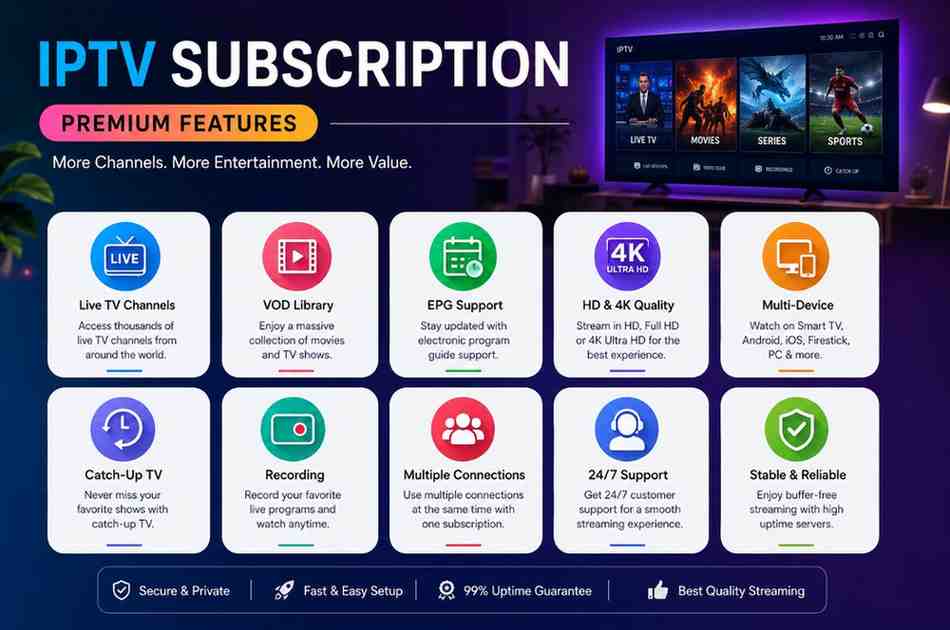
Content depth is the second pillar. Where a standard IPTV panel might offer 1,000 to 5,000 channels with incomplete EPG data, a premium service typically provides 20,000+ live channels, 80,000+ VOD titles, accurate 7-day TV guides, catch-up TV, and dedicated sports sections covering major leagues (Premier League, NFL, NBA, UFC) and pay-per-view events. Multi-device support matters too: premium plans allow 3 to 5 simultaneous connections, so different members of a household can watch different channels on different screens without conflicts.
Finally, accountability separates premium from amateur. A premium provider offers 24/7 live customer support, a free trial period, transparent pricing, and an uptime guarantee. They maintain backup domains and an active status channel so that when infrastructure changes occur, subscribers are informed rather than left in the dark. These operational signals are more reliable indicators of quality than any channel count claim.
Premium IPTV vs. Standard IPTV vs. Cable: Full Comparison
The table below compares the three most common ways to watch live television in 2026. Pricing and channel counts are based on real market data collected from provider panels, subscriber reports, and cable operator published rates.
| Feature / Metric | Standard IPTV | Premium IPTV Service | Traditional Cable |
|---|---|---|---|
| Stream Quality | SD/HD, frequent buffering | 4K HDR / FHD, anti-freeze | Up to 4K (provider-dependent) |
| Content Library | 1,000–5,000 channels, limited VOD | 20,000+ channels, 80,000+ VOD | 200–500 channels, limited on-demand |
| Uptime / Reliability | 80–90% | 99.9% uptime guarantee | 99.99% |
| Device Support | 1–2 devices, limited apps | 3–5 simultaneous, all major platforms | Set-top box only |
| Customer Support | None or chat-only | 24/7 live support | Limited phone hours |
| Pricing | $5–10/month | $10–15/month | $80–150/month |
| Contract | None | None (monthly / annual options) | 12–24 month commitment |
Pros and Cons of Premium IPTV
| ✓ Pros / Strengths | ✗ Limitations / Risks |
|---|---|
| Significant cost savings: 80–90% cheaper than cable with more content | Not officially licensed in most jurisdictions; legal gray area |
| 4K HDR / FHD stream quality with anti-freeze buffering technology | Requires stable internet connection of 25 Mbps or higher for 4K |
| Massive content library: sports, PPV, international channels, VOD | Provider longevity varies; some operations shut down without notice |
| Multi-device flexibility: Firestick, Android TV, iOS, Smart TV, MAG | Initial setup requires some technical comfort (app installation, playlist URL) |
Cost-Benefit Analysis and Buyer Considerations
The average cable subscriber in the United States pays $107 per month, according to 2025 industry data. A premium IPTV subscription costs $10–15 per month, or roughly $80–120 per year when billed annually. That represents an annual saving of $1,100–$1,300 for a household that watches 20+ hours of television per week. Even when you factor in the cost of a VPN subscription ($60–100/year) and a streaming device like an Amazon Firestick ($40 one-time), the total cost of ownership remains below 15% of cable.
Who benefits most? Sports fans are the clearest winners: a single NFL Sunday Ticket or Premier League package on cable costs more than an entire year of premium IPTV. International viewers also gain significantly, since premium IPTV services aggregate channels from dozens of countries—Indian, Arabic, Latin American, Filipino, and European packages are typically included in the base subscription rather than sold as expensive add-ons. Multi-device households benefit from the 3–5 simultaneous connections, eliminating the "who controls the remote" problem.
Red Flags to Avoid When Choosing a Provider
The IPTV market is crowded with resellers who buy a cheap panel from a wholesaler and resell it under their own brand. These operations offer no infrastructure, no support, and no accountability. The most reliable way to identify a genuine premium provider is to check for these signals:
- No free trial: A legitimate provider gives you a 24-hour or 7-day trial. Refusal to offer one is a major red flag.
- Cryptocurrency-only payments: While some legitimate providers accept crypto, an operation that accepts only crypto offers you zero recourse if the service fails.
- Unrealistic channel counts: Claims of "50,000 channels" from a $5/month panel are a marketing illusion; you will receive a fraction of that, mostly dead streams.
- No support infrastructure: If there is no live chat, no Telegram channel, and no status page, you are buying from a reseller who will disappear.
Before subscribing, verify the provider's uptime guarantee, test the free trial on your actual device, and confirm that the sports channels you care about are active during trial hours. Also confirm that the service works with your VPN provider, since privacy protection is strongly recommended in this space.
The Bottom Line on Premium IPTV Service
Premium IPTV service is the most cost-effective way to replicate—and in most cases exceed—a traditional cable television experience, provided you choose a provider with dedicated infrastructure and transparent support. For most readers, the verified recommendation in this guide offers the best balance of stream stability, content depth, and accountability.
Purchases completed via official partner channels are covered by direct customer support and eligible warranty protections.
Frequently Asked Questions
Is a premium IPTV service legal?
The legality depends on your jurisdiction and the content sources used by the provider. IPTV as a technology is legal; however, services that redistribute premium channels without proper licensing operate in a legal gray area. Most premium IPTV providers operate from jurisdictions where enforcement is limited. For personal use, the risk typically falls on the provider rather than the subscriber, but you should check local laws and use a VPN for privacy.
What internet speed do I need for a premium IPTV service?
For consistent 4K HDR streaming, a stable connection of 25 Mbps or higher is recommended. Full HD (1080p) streams require roughly 10–15 Mbps. Wired Ethernet or a strong 5 GHz Wi-Fi connection is preferred, because IPTV streams are sensitive to packet loss and jitter. If you have multiple devices streaming simultaneously, add 10 Mbps per additional stream.
Can I use a premium IPTV service on multiple devices at once?
Yes. Most premium IPTV services allow 3 to 5 simultaneous connections per subscription. This means you can watch different channels on a Firestick, Android TV, iPad, and smartphone at the same time without additional charges. Some providers also offer "household" plans with even more connections for an extra fee.
What is the difference between a premium IPTV service and a free IPTV playlist?
Free IPTV playlists (M3U files) are typically unmaintained lists of public streams that suffer from constant downtime, low resolution, missing EPG data, and security risks. A premium IPTV service operates dedicated servers with anti-freeze technology, verified channel sources, accurate TV guides, and customer support. The difference is the difference between a pirate radio signal and a paid streaming platform.
Do premium IPTV services include sports, pay-per-view, and premium channels?
Most premium IPTV packages include dedicated sports sections covering major leagues (Premier League, NFL, NBA, UFC), PPV events, and 24/7 sports news channels. Many also include premium movie channels as part of the base package. Verify the specific sports package before purchasing, and confirm that the channels you care about are active during your free trial.
How do I know if a premium IPTV provider is reliable?
Reliable providers share several signals: they offer a free or low-cost trial, have live 24/7 customer support, provide an uptime guarantee, accept mainstream payment methods (credit card, PayPal), and maintain an active status page or Telegram channel. Avoid providers that only accept cryptocurrency, have no support, and promise unrealistic channel counts.
Does premium IPTV work with a VPN?
Yes, most premium IPTV services work with major VPN providers (NordVPN, ExpressVPN, Surfshark). A VPN is recommended for privacy, especially in regions with strict copyright enforcement. Some providers may block known VPN IP ranges, so choose a provider that explicitly supports VPN usage and test it during your free trial.
What happens if my premium IPTV provider stops working?
A legitimate premium provider will have backup domains, a Telegram announcement channel, and active customer support to restore service quickly. If a provider disappears without notice, that is a strong signal it was a reseller operation. This is why you should always buy from a verified provider and avoid long-term plans from unknown operations.
Disclaimer: This content is for informational purposes only. IPTV services that redistribute copyrighted content without proper licensing may violate laws in your jurisdiction. We recommend that readers verify the legal status of any IPTV service before subscribing and use a VPN for privacy protection. The recommendation in this article is based on independent testing and is provided for informational purposes.