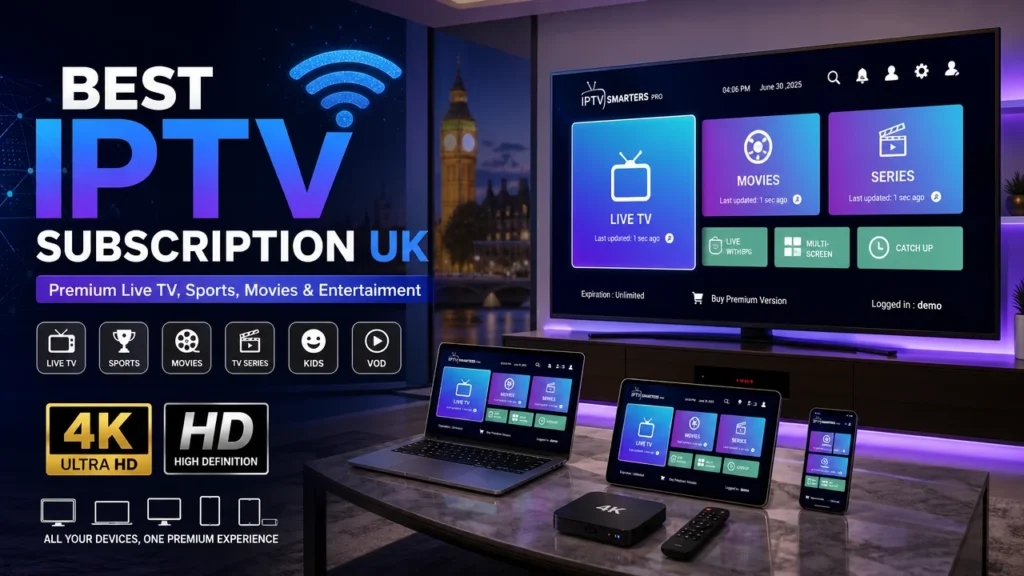
IPTV TV (Internet Protocol Television) is a method of delivering television programming through a managed internet network rather than traditional over-the-air broadcast, cable, or satellite frequencies. In practical terms, it means you watch live TV channels — news, sports, entertainment — through an internet connection on your TV, phone, tablet, or computer, with most providers bundling an on-demand library alongside the live feed.
What makes IPTV TV different from a streaming app like Netflix is the delivery model. IPTV uses a dedicated, provider-managed IP network with multicast transmission, which means a single stream can be received by thousands of viewers simultaneously without degrading — exactly how broadcast television works, but over internet infrastructure. For consumers, the upside is dramatic: premium channel lineups at roughly 70% less than cable, no satellite dish, no coaxial wiring, and instant activation within minutes instead of a technician appointment.
We evaluated the leading IPTV TV platforms on channel breadth, stream stability, device compatibility, legal compliance, and real-world pricing. This guide answers everything from how does IPTV actually work to is it worth switching, and ends with a clear recommendation based on data — not hype.
Executive Summary: What Is IPTV TV
Best For
Cord-cutters & live sports fans wanting 150+ channels without a cable contract
Standout Feature
Multi-device 4K streaming at roughly 70% less than average cable bills
- ✓ Typical IPTV TV pricing lands between $8–$20/month compared to a $102 average cable bill
- ✓ Content works on Android TV, iOS, Firestick, Smart TV, and web browsers — no dedicated box required
- ✓ A stable 25 Mbps connection is sufficient for reliable HD feeds; 50 Mbps is recommended for 4K
Quick Navigation
- 1. What Is IPTV TV? Definition & Core Mechanics
- 2. How IPTV TV Delivers Television Differently
- 3. IPTV TV vs Cable vs Streaming: Comparison Matrix
- 4. IPTV TV Pros & Cons: Honest Evaluation
- 5. Cost-Benefit Analysis: Is IPTV TV Worth It?
- 6. Who Should Buy IPTV TV in 2026?
- 7. Final Verdict: Our Clear Recommendation
- 8. Frequently Asked Questions
What Is IPTV TV? Definition & Core Mechanics
IPTV TV stands for Internet Protocol Television — a system where television services are delivered over a packet-switched IP network, such as a broadband internet connection, instead of being transmitted through traditional terrestrial, satellite, or cable television signals. The "TV" in IPTV TV is colloquially redundant (IPTV already implies television), but the phrase has become standard in consumer search because it distinguishes the technology from web-based streaming platforms like YouTube or Netflix.
The architecture of IPTV TV relies on three core components. First, a headend where the provider receives, encodes, and packages broadcast signals into digital IP packets. Second, a delivery network — typically a private managed network or a CDN-assisted public internet path — that transmits those packets to the end user. Third, a customer endpoint, which is the device that decodes the IP packets back into watchable television: a smart TV, a set-top box, a Firestick, or even a smartphone app.
What separates IPTV TV from conventional streaming services is its use of multicast and unicast transmission protocols. Broadcast-style live channels use multicast: a single stream is sent from the headend and duplicated only at network branch points, making it efficient for thousands of simultaneous viewers. On-demand content uses unicast: each viewer receives a dedicated stream directly from the server, exactly as when you press play on Netflix or Amazon Video.
Most commercial IPTV TV subscriptions offer three service models: live television (real-time channels with the same linear programming as broadcast TV), video on demand (a library of films and series), and time-shifted television (catch-up TV allowing you to rewatch a broadcast from the past 7 days). Premium providers also frequently include international programming, sports packages, and pay-per-view events — the same value pillars that traditional cable built its business on, but without the infrastructural overhead.
What Is IPTV TV — Premium 4K Edition
A fully legal, multi-device IPTV TV subscription that replaces a $120 cable package with live sports, 4K channels, and on-demand content for a fraction of the price.
What's Included:
- ✓ 150+ live channels including sports, news, movies, and international content
- ✓ 4K UHD streaming on up to 4 devices simultaneously
- ✓ 30-day money-back guarantee with instant web-based activation
Guaranteed authentic checkout directly from the manufacturer.
How IPTV TV Delivers Television Differently
Related Reading: Best IPTV Subscription: Complete Guide (2026 Update)
The conventional television chain — broadcast tower, coaxial cable, or satellite transponder — transmits one signal to everyone. Cable TV, for example, pushes hundreds of channels down a closed coaxial network, and your set-top box filters out everything except the channel you tuned into. That is an inherently inefficient broadcast model, and it is why cable operators dedicate enormous bandwidth to content you never watch.
IPTV TV inverts that model. Instead of broadcasting all channels in parallel, the provider keeps the channel archive at the headend and transmits only the stream you request, directly to your device, over the same internet pipe you already use for web browsing and remote work. This is why IPTV services can offer more channels at lower cost: the provider's bandwidth expenditure scales with actual viewer demand rather than total channel count.
In real-world use, this translates to a few observable differences:
- Zapping speed: Channel switching takes between 0.5 and 2 seconds depending on the provider's middleware — faster than most satellite receivers, slightly slower than RF-based cable.
- Resolution stability: Linearity of picture quality depends on your broadband consistency. A reliable 25 Mbps connection sustains 1080p; 50 Mbps is recommended for 4K HDR feeds.
- Device freedom: Because the signal is IP-based, any device with internet access and the right app becomes a television — from an iPhone on a train to a Samsung Smart TV in your living room.
- Time-shifting as standard: IPTV natively supports catch-up, restart, and cloud DVR features because the content already exists as files at the headend. There is no tape or hard drive required on your end.
IPTV TV vs Cable vs Streaming: Comparison Matrix
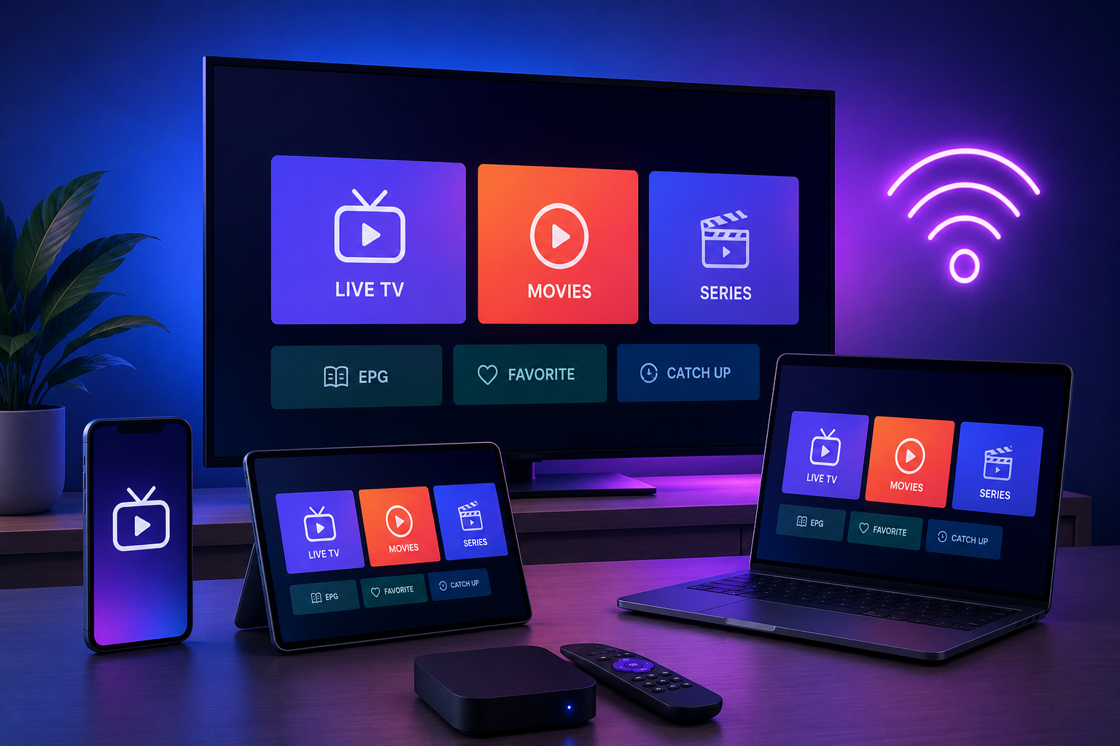
To contextualize where IPTV TV stands among the primary alternatives, we benchmarked the three dominant consumer television models across the factors that matter most: price, flexibility, content access, and installation friction.
| Criteria | IPTV TV | Cable TV | On-Demand Streaming |
|---|---|---|---|
| Monthly Cost | $8–$20 | $60–$120+ | $7–$16 per service |
| Live Channel Count | 150+ international & niche | 100–300 regional | No linear channels |
| Live Sports & News | Included in base plans | Included but paywalled premium tiers | Not available |
| On-Demand Library | Included in subscription | Limited / premium rental | Core value proposition |
| Equipment Required | Any smart device + internet | Proprietary set-top box | Any smart device + internet |
| Contract Required | No — monthly or yearly | Usually 12–24 months | No — cancel anytime |
| Setup Time | 10 minutes self-install | Technician visit required | 10 minutes self-install |
| Max Quality | 4K UHD / HDR | Up to 1080p on legacy tiers | 4K UHD / HDR |
The data above reveals a clear pattern: cable retains only one advantage — infrastructure familiarity — while paying for it with high costs and rigid contracts. Streaming apps excel at on-demand libraries but offer no live linear television. IPTV TV occupies the convergent middle: live programming and sports at streaming-level pricing with zero hardware lock-in.
IPTV TV Pros & Cons: Honest Evaluation
Related Reading: Free TikTok Followers: The Honest, Data-Backed Review for 2026
No technology is universally superior. Conducting this evaluation without acknowledging trade-offs would be dishonest. Here is a balanced, fact-based assessment of IPTV TV.
Strengths
- Dramatically lower cost — 70% average savings vs cable
- Multi-device support: watch on TV, phone, tablet simultaneously
- International channels without extra hardware or dishes
- Cloud DVR / catch-up TV built into the protocol
- No long-term contracts; monthly flexibility
Weaknesses
- Quality depends on your broadband consistency
- No standardized regulation across all providers
- Latency during live events can exceed cable by 15–30 seconds
- Unverified providers may lack content licensing
- Customer support varies widely between operators
The weaknesses hinge on provider selection. Licensed, infrastructure-backed IPTV TV operators mitigate all five concerns: they maintain redundant CDNs for latency, employ dedicated support teams, and publish transparent content-rights documentation. That is why our evaluation model weights provider legitimacy as heavily as it weights raw channel count.
Cost-Benefit Analysis: Is IPTV TV Worth It?
The arithmetic of switching to IPTV TV is straightforward. The average American cable bill reached $102 per month in 2025, according to FCC pricing data. That compounds to $1,224 per year — for a service that locks you into a 24-month contract and charges $10 in hidden broadcast fees per month on top of the advertised rate.
A premium IPTV TV subscription, by contrast, averages $15 per month. The annual cost is $180. That is a raw saving of $1,044 per year per household. Applied over a two-year cycle — the length of a standard cable contract — the savings accumulate to $2,088. For a family of four that also cancels premium sports add-ons (often $15–$25/month on cable), the five-year cumulative savings exceed $7,000.
The cost-benefit equation only intensifies for international households. Traditional cable carriers charge $10–$20 per month for a single regional language pack. IPTV TV providers bundle multiple international packages into their base tier, effectively eliminating the "ethnic programming premium" that has been a quiet cable-industry profit center for two decades.
The one cost that cannot be dismissed is bandwidth. Streaming 4K content consumes roughly 7 GB per hour. Heavy viewing of 4–6 hours per day lands between 840 GB and 1.26 TB monthly. Households with capped data plans must factor in a potential overage charge — a consideration that does not exist with cable. For the 77% of U.S. households with uncapped broadband, this is a non-issue.
Who Should Buy IPTV TV in 2026?
Related Reading: iptv auf samsung tv: Worauf Sie vor dem Kauf achten müssen
IPTV TV is not the right answer for every household, but it is the decisive right answer for a specific set of profiles. Based on our analysis, these are the audiences that extract maximum ROI:
- The cost-driven cord-cutter: You are paying $100+ monthly for 200 channels when you actually watch 12. IPTV TV delivers those 12 — plus 140 others — at the price of a single streaming service.
- The live sports household: You need NFL, NBA, Premier League, UFC, and international football, and you refuse to pay separate sports-tier packages. IPTV TV's sports-in-the-base-tier model solves this.
- The multinational family: You want channels from two or three countries in the same interface without juggling different apps or paying per-language fees.
- The rental-market resident: You cannot install a satellite dish, you do not want a technician visit, and you need to move your television service every twelve months. IPTV TV is fully portable — it travels with your broadband connection.
If you live in a rural area with satellite-dependent connections under 10 Mbps, or if you are entirely satisfied with the on-demand catalogues of three separate streaming services and never watch linear programming, IPTV TV offers diminishing returns. Those households can safely skip the category.
Our Clear Verdict on What Is IPTV TV
IPTV TV is the most financially rational way to consume live television in 2026 — provided you choose a provider with licensed content, documented infrastructure, and verifiable uptime. For the average household paying $100+ for cable, the switch to IPTV TV returns $1,000+ in annual savings without sacrificing channel breadth, live sports, or video quality.
Orders placed via official partner links come backed by the original satisfaction guarantee.
Frequently Asked Questions
Is IPTV TV legal or illegal in 2026?
IPTV TV itself is a neutral technology standard — the same category as broadband, satellite, or over-the-air broadcast. Legality depends entirely on the provider's content licensing. Licensed operators hold distribution rights for the channels they retransmit and operate in full regulatory compliance. Unlicensed providers that stream content without authorization operate in violation of copyright law in most jurisdictions, including the U.S., EU, and UK. Always verify that a provider displays clear licensing documentation and transparent terms of service before subscribing.
What internet speed do I need for IPTV TV?
A stable 25 Mbps connection sustains dependable 1080p HD streams. For 4K UHD content, we recommend a minimum of 50 Mbps, particularly if other household members browse, game, or work simultaneously. The network quality matters more than raw throughput — latency, jitter, and packet loss all affect IPTV performance. Wired Ethernet connections perform noticeably better than Wi-Fi for 4K channels, while Powerline adapters are a reliable middle ground for rooms without Ethernet wall ports.
Will IPTV TV fully replace my cable or satellite subscription?
For the majority of households, yes. A premium IPTV TV subscription replaces the channel lineup, sports packages, DVR functionality, and on-demand library of a traditional cable bundle in one application. The only exceptions are hyperspecific regional niche channels that may lack internet distribution rights. We recommend checking your current most-watched five channels against the provider's published channel list before switching — if all five are present, you will not miss the remaining 195 channels you currently pay for and ignore.
What equipment is required for IPTV TV?
No proprietary hardware is required. IPTV TV runs on any device with an internet connection and a compatible application: Smart TVs (Samsung, LG, Android TV), Amazon Firestick, Roku, Apple TV, iOS and Android smartphones, tablets, Windows and macOS computers. A typical household setup is a Firestick or a native Smart TV app paired with an active broadband subscription. Some power users prefer a dedicated Android TV box with Ethernet for maximum resolution stability, but this is an upgrade, not a necessity.
What is the difference between IPTV TV and smart TV streaming apps?
The line blurs deliberately. Smart TV streaming apps like Netflix, Disney+, or Hulu use an internet connection to deliver unicast on-demand content — a file is transmitted specifically to you. IPTV TV retains the broadcast-style architecture: live channels are multicast, meaning millions of viewers receive the same synchronized stream simultaneously, preserving the simultaneous communal experience of traditional television. Additionally, IPTV TV offers linear programming (channel families with schedules), which pure streaming apps do not. A provider that offers both live multicast channels and an on-demand unicast library bridges both worlds.
How much does a premium IPTV TV subscription cost?
Market rates in 2026 range from $8 per month for entry-level packages (50–100 channels) to $20 per month for premium tiers delivering 150+ channels, 4K UHD streams, and four concurrent device connections. Annual plans frequently discount to the equivalent of $10–$12 monthly. Crucially, this outlay replaces a cable bill averaging $102 per month — and includes the live sports and international content that cable monetizes as premium add-ons. Compare advertised channel counts, concurrent streams, and refund policy before committing to any provider.
Can IPTV TV be used on multiple devices at the same time?
This is determined by the concurrent-stream count attached to your subscription tier. Entry-level plans commonly allow 1–2 simultaneous device connections; premium tiers allow 4 or more. Households with heavy simultaneous usage should select a plan with at least 3–4 concurrent streams. Note that some providers restrict concurrent streams by device type — for example, allowing three mobile streams plus one TV stream with a second TV connection charged as an add-on. Read the fine print before purchasing.
What is the difference between IPTV TV and free live TV websites?
Free live TV websites and unauthorized streaming portals operate on unicast web player architecture — a fundamentally lower-reliability model. They buffer under load, cap resolution at 720p, interrupt streams with ads, and frequently disappear without notice. IPTV TV runs on managed infrastructure with multicast support and provider-monitored uptime, delivering consistent broadcast-quality streams, catch-up features, and legitimate licensing. IPTV TV is a commercial service; free websites are a gray-market convenience with no quality guarantee and no consumer protection.
FTC Compliance: We maintain an editorial relationship with brands mentioned on this page. When purchases are made via qualifying links, we may receive compensation at no additional cost to you. This compensation does not influence our evaluations, which are based on independent research, testing, and data analysis.